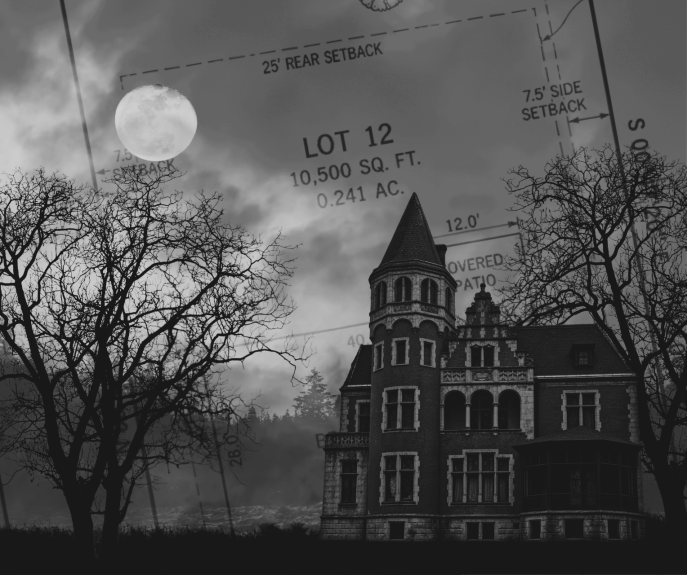
October is the season for ghosts, goblins, haunted houses, and things that go bump in the night. But for real estate lawyers and title professionals, there may be something even scarier hiding in a closing file: a fraudulent survey. And unfortunately, this one is not wearing a costume.
An emerging form of real estate fraud involves property surveys that have been fraudulently altered or, in some instances, completely fabricated. With today’s sophisticated graphic-editing software and artificial intelligence tools, changing a document has become frighteningly easy. Even worse, the finished product can look remarkably authentic. That means the survey sitting in your closing file may not always be what it appears to be.
A Survey With a Few Tricks
Fraud-prevention reports have described schemes in which existing surveys were allegedly manipulated to conceal or misrepresent conditions affecting property. Examples have included an existing survey allegedly altered to remove an improvement, as well as a fabricated survey allegedly omitting structures encroaching into an easement.
Now you see it. Now you don’t. These are not harmless edits. A survey can play an important role in identifying or evaluating boundaries, improvements, easements, encroachments, and other physical matters that may affect the title to or use of the property.
But remember that the survey and title examination serve different functions. A clean-looking survey does not eliminate matters disclosed by the public record, and a survey should not be treated as a substitute for a proper title examination. When the survey, legal description, recorded documents, and conditions on the ground do not seem to tell the same story, that discrepancy deserves further investigation.
Look for the Survey’s Skeletons
Unfortunately, there may not be one obvious clue that a survey has been manipulated. Still, a few red flags should cause you to take a closer look:
Inconsistent fonts, text sizes, spacing, or formatting.
Letters or numbers that appear to float, lean, or otherwise differ from surrounding text.
Smudges, unusually faint lines, white areas, or other indications that information may have been removed or replaced.
A surveyor’s signature or seal that appears misaligned, copied and pasted, or visually disconnected from the document.
Differences between the property’s legal description and what is depicted on the survey.
A recorded easement or other matter revealed by the title examination that an apparent current survey unexpectedly fails to depict or reference.
Electronic file creation or modification dates that do not reasonably correspond with the purported date of the survey or revision.
None of these things, standing alone, necessarily proves fraud. Documents are frequently scanned, copied, downloaded, combined, and converted into different electronic formats. Unusual metadata or formatting should therefore be treated as a reason to ask questions, not proof that a survey has been fraudulently altered.
Don’t Be Haunted by a Fake Survey
Fortunately, one of the best defenses against survey fraud is surprisingly low-tech: independent verification. Whenever practicable, obtain the survey directly from the licensed surveyor or independently confirm with the surveyor that the version provided for the transaction is authentic. If a survey comes from the seller, buyer, real estate agent, or another third party, consider independently identifying and contacting the surveyor to verify the document.
And here is an important point: do not rely exclusively on the phone number or email address printed on a questionable survey. If someone has gone to the trouble of fabricating a survey, creating fraudulent contact information is not much of a leap. Independently locating the surveyor’s legitimate contact information provides an additional safeguard.
The Same Old Fraud Lesson, Wearing a New Costume
Title professionals have already learned an important lesson from years of combating wire fraud and other real estate scams: trust but verify. The same principle applies here.
Technology continues to make document manipulation easier and more convincing. That does not mean every imperfect-looking survey should send the closing attorney running from the building like the last scene of a horror movie. It does mean we should resist accepting a document at face value when something does not look right. Fraudsters may have some new tricks.
Our best treat remains the same: slow down, ask questions, compare the survey with the title evidence, and independently verify before relying on the document. Because when it comes to property surveys, the scariest problems may be the ones somebody has carefully erased.
The South Carolina Court of Appeals recently issued another decision overturning a local zoning decision on procedural grounds. In Lambert v. Aiken County Planning Commission, the Court reversed a zoning permit approval because the Commission failed to document the findings and reasoning supporting its decision.
The controversy began with the creation of a residential equestrian community known as Bluffwood East. The developer recorded a set of covenants and restrictions prohibiting commercial activities within the development.
Some years later, the developer acquired a separate parcel of land that was adjacent to Bluffwood East. The developer conveyed portions of this new property to Lambert and Beamish, the appellants in this case. Notably, the developer’s deeds into Lambert and Beamish expressly incorporated the Bluffwood East covenants and restrictions.1
However, the developer retained the remainder of this parcel and eventually conveyed it to a trust. The developer’s deed into the trust did not specifically reference or attach the Bluffwood East restrictions.
Years later, the trust entered into an agreement with a contractor of Verizon to construct and operate a wireless communications tower on the property. When Verizon’s contractor sought a permit from the Aiken County Planning Commission, Lambert and Beamish, who were neighboring property owners, appeared and objected to the issuance of the permit.
Lambert and Beamish argued that the Bluffwood East covenants and restrictions prohibited any commercial activity within the subdivision and therefore barred the issuance of a permit for the cell tower. Verizon’s contractor argued that the cell tower parcel was never subjected to those covenants restrictions because it was not part of the original development and unlike the deeds into Lambert and Beamish, the deed into the trust did not incorporate the restrictions.
After several hearings, the attorney for the Commission wrote the parties acknowledging that South Carolina law generally prohibits a local planning agency from approving a project when it has actual notice that restrictive covenants prohibit the proposed use. However, the county attorney noted that planning authorities are not required to independently search the land records to determine whether these restrictions exist. The attorney asked that the parties submit additional information concerning the applicability of the covenants and restrictions so that the Commission could make its final decision as to whether the restrictions applied.
Verizon’s contractor responded by providing copies of the deeds in its chain of title, noting that there was not any reference to restrictions in these deeds, and taking the position that the restrictions did not burden the tower parcel. The neighboring owners apparently did not submit any additional evidence supporting their contention that the covenants and restrictions applied to the tower parcel.
The Planning Commission subsequently approved the permit perhaps reasoning that Lambert and Beamish had the burden of showing that the restrictions applied. However, the permit approval did not specifically address the restrictive covenant issue or explain how the Commission resolved the competing arguments. Lambert and Beamish appealed to circuit court, which affirmed the Planning Commission’s decision. The circuit court concluded that the covenant issue had effectively been waived. The Court of Appeals disagreed.
The Court of Appeal’s primary concern was procedural. South Carolina requires planning commissions to maintain records of their findings and determinations. While the record contained the hearing transcripts and submissions of the parties, the Court found that the permit approval did not adequately explain the reasoning of the Planning Commission in resolving the contested issues. It found the Commission’s findings insufficient to support its ultimate approval of the permit and remanded the matter for additional proceedings.
Further, the Court rejected the notion that the restrictive covenant issue had been waived. It found that the neighboring owners repeatedly raised the issue throughout the administrative process and on appeal. Whether the covenants ultimately applied was a separate question, but the Court concluded that the issue had been preserved and required consideration.
The immediate takeaway from the Court’s ruling is that local boards and commissions must be sure that their minutes, resolutions, and written determinations identify the facts found, the legal standards applied, and the rationale supporting the ultimate decision. If it was not clear before this ruling that Planning Commissions are subject to these standards, the Court has put local commissions on notice of it now.
The decision also offers guidance to local boards when considering restrictive covenants in the zoning context. Once a planning authority receives notice that restrictive covenants may prohibit the issuance of a permit, simply ignoring the issue is risky. Even if the authority ultimately concludes the restrictions do not apply, the reasoning behind that conclusion should be reflected in the record.
For the dirt lawyer in me, the unresolved covenant question may be the most interesting part of this opinion. There seems to be a good argument that the tower parcel was never subjected to the original Bluffwood East restrictions. The parcel came from a later-acquired tract, and unlike the deed to the neighboring owners, the deed conveying the tower parcel did not expressly incorporate the restrictions. The Court’s opinion does not reference any other evidence of a common development scheme incorporating the entire later-acquired property into the development, but perhaps there might be more evidence out there that was not discussed. In any event, Lambert continues a growing trend in South Carolina appellate decisions requiring administrative bodies to show their work. For zoning officials, the message is straightforward: make findings about all of the issues raised and incorporate them into the record. For attorneys and paralegals handling land-use disputes, the case underscores the value of developing and preserving issues at the administrative level. For the rest of us, it provides a useful reminder that restrictive covenant questions can arise in unexpected places and may emerge unexpectedly when
A copy of the recorded covenants and restrictions was attached as an exhibit to the deeds.
South Carolina’s recently enacted “anti-squatter” law provides real estate practitioners with a valuable tool to help property owners quickly regain possession of residential property from certain unauthorized occupants. The legislation creates an expedited process for removing true squatters while preserving existing protections for legitimate tenants. It also strengthens landlords’ rights during eviction appeals. For reference, the text of the Act can be found here.
Why does this matter to real estate clients? Before this law, an owner who discovered an unauthorized occupant in what was supposed to be a vacant home often faced a lengthy and expensive court process to evict the occupant. Under the new statute, property owners may seek expedited relief through magistrate court when an individual occupies residential property without permission and has no legitimate tenancy rights. As long as the property owner can provide a verified (signed by the property owner on his or her own knowledge) petition to file, the new law authorizes a magistrate to order a quick (potentially as quickly as same-day) ex parte eviction of a true squatter – someone who has no legitimate right – such as a residential lease – to be in the property.
For South Carolina real estate attorneys and paralegals, this could open up opportunities to provide practical value to clients. For example:
• Assisting sellers who discover unauthorized occupants in their residential investment property. • Helping purchasers of vacant homes, inherited property, foreclosed/REO houses, or investment properties, to evict unauthorized folks and obtain possession more quickly. Care still needs to be taken in investigating whether the occupant may have a legitimate lease agreement from the former owner. • Advising landlords on whether an occupant is a true squatter or should instead be handled through traditional residential landlord-tenant eviction procedures. • Lender’s counsel may want to discuss with their lender or servicer clients who could be dealing with vacant collateral residential properties.
Actual possession remains an important issue during underwriting and closing. Title agents should continue to ask about any occupants in possession at closing, and discuss with an underwriter if needed.
The new law also addresses an older existing issue in which tenants who were appealing an eviction could effectively “game” the system by staying in the property without paying rent while their appeal was pending. Now, tenants who have appealed an eviction order are required to sign an affidavit that they will continue paying rent, or face prompt eviction if they do not do so.
An additional provision of the new law applies to RV park operators and opens up more robust actions the operators may take to remove park guests who violate park rules, do not pay, use illegal drugs, or disturb other guests.
The bottom line is that the new law provides a faster and more practical path for removing unauthorized occupants and should be viewed as another tool in the real estate practitioner’s toolbox. Attorneys and paralegals who understand the distinction between squatters and tenants, and who proactively educate clients about the new procedure, will be in a good position to help protect real estate transactions, reduce delays, and strengthen long-term client relationships, while remaining mindful of the title and possession issues that may still arise.
If you have ever practiced law, you’ve experienced that one crazy, busy week where so much was going on that an important, but not urgent, task got pushed to the back burner. Most of us have had such a task slip completely out of our consciousness for longer than we would care to admit. These are the things that make us sit upright in bed at 2:00 A.M. Isn’t the practice of law fun?
Real estate practice, perhaps more than any other area of the law, involves countless small but vital tasks that must be taken care of after the closing table has been left behind. Some of these tasks are obviously urgent such as timely recording documents and sending out disbursements. Other matters, such as pursuing releases or delivering the final title policy to the insured, may seem less urgent. Well, the South Carolina Supreme Court recently issued a disciplinary opinion that should be a reminder that failing to follow through on the latter categories can still put a license at risk.
According to the Court’s opinion, the attorney who was disciplined operated a solo law practice that handled at least some real estate closings. In connection with a commercial closing, the attorney collected $10,803.00 in title policy premium and attorney’s fees. During a particularly busy time, their practice forgot to issue the title policy following closing. As the attorney began closing the practice and moving to inactive status, the title policy remained outstanding and was never issued. However, her client did not forget. The client’s attempts to contact the attorney about the status of the policy went unanswered. The result was a complaint and the ensuing disciplinary action.
In reviewing the case, the Court noted the attorney’s failure to produce the title policy and failure to respond to the client constituted violations of Rules:1.3 (diligence), 1.4 (communication), 1.15(a) (safekeeping of client property), 1.16(d) (return of client property), and Rules 8.4(a) and 8.4(d) of the Rules of Professional Conduct.
This opinion reminds us that the title insurance premium in a real estate transaction comes from client funds. An attorney may serve as both the settlement agent and the title insurance agent in the same transaction. When that occurs, disbursing the title insurance premium before issuing the promised policy raises concerns about the attorney’s obligations to properly handle client funds and complete the representation.
My experience working for a title insurance underwriter has been that most insureds are reasonably patient with the delivery of title policies, but that patience disappears when they do not receive timely responses from counsel. Lenders generally get very demanding when they realize that title policies are missing from their file at audit times, because FNMA/FHLMC guidelines may dictate financial consequences to the originating lender or servicer. A lender often contacts the attorney and then the title insurance company seeking production of the policy, but their next step is often the filing of a Bar complaint.
In this disciplinary action, the Supreme Court publicly reprimanded the inactive attorney. The Court required restitution be made to the client for the title premium and attorney’s fee and to reimburse ODC for its fees and costs. The Court further required that the attorney complete Ethics School before returning to active practice.
This blog has discussed the limits of fractional ownership before. Short-term rentals continue to be a subject of controversy in South Carolina, particularly in the communities surrounding Charleston. Recently, this blog discussed the Court of Appeals decision overturning a Sullivans Island zoning determination that fractional ownership structures violated the Town’s limitation on vacation rentals. Now, a Circuit Court judge in Charleston County has invalidated Folly Beach’s referendum enacted short-term rental cap.
The ordinance at issue originated in an unusual way. In 2022, Folly Beach City Council rejected a proposal that would have capped the number of short-term rentals within the city. Supporters of the proposal turned to South Carolina’s initiative and referendum process and eventually submitted a petition seeking adoption of substantially the same restrictions. After City Council declined to adopt the ordinance a second time, the matter was placed before the town’s voters and narrowly passed by referendum.
The ordinance placed a hard cap on the number of short-term rental licenses the town could issue to properties that were not the primary residence of the owners. Because property owners with existing licenses in good standing were grandfathered in under the ordinance, the effect of the ordinance was that no new licenses could be issued until the number of licenses dipped below the hard cap of 800.
The challenger to the statute was an owner with an existing license that the City determined was not in good standing to be renewed. The owner challenged the ordinance on the ground that the ordinance was unconstitutionally enacted through the referendum process.
Although the stated goal of the ordinance was to regulate the number of short-term rentals, the Circuit Judge found that the effect of the ordinance was to limit the City’s authority to issue short-term rental business licenses. Because a business license fee is treated under South Carolina law as a tax, the court concluded that the ordinance was not lawfully enacted, because South Carolina’s expressly prohibits initiatives that appropriate money or authorize the levy of taxes.
The court found that the ordinance defined when the City could issue business licenses and collect the corresponding business license taxes. Reasoning that giving voters the option to restrict the City’s ability to levy taxes and fees by referendum would undermine the ability of elected bodies to maintain control over municipal revenues. The Court therefore ruled that the short-term rental cap provisions are void.
The Town will appeal the Court’s ruling and separately has voted to place a six-month moratorium on the issuance of new short-term rental licenses while it studies the issue further and considers repealing and replacing the short-term rental ordinance with something new.
This case is another reminder of the difficulties faced by towns where there is a substantial tourism industry where it comes to short-term rentals. In most places, there is significant support behind both sides of the issue and while there seems to be a great deal of energy behind those citizens who would seek to limit the impact of short-term rentals on their communities, motivated investors and owners of vacation homes seem equally motivated to defend their property rights.
The controversy is a good reminder that restrictions on the use of property must be implemented through legally authorized governmental processes and that there is a perhaps equal number of motivated investor owners who will ask the courts to be the ultimate referee.
South Carolina’s 2025-2026 legislative session demonstrated that land use and zoning issues are becoming increasingly prominent in economic development, environmental regulation, and local governance. While relatively few zoning-related bills were enacted, several significant proposals and the ongoing Data Center litigation in Spartanburg County and the Silfab Solar controversy in York County reveal growing tension between economic growth initiatives and community oversight. For South Carolina real estate attorneys, these developments may foreshadow a more active and contentious zoning landscape in the years ahead.
Legislative Efforts to Expand Zoning Oversight
One of the most notable zoning bills introduced during the session was Senate Bill 530. The bill proposed adding Section 6-29-815 to the South Carolina Code and would have required development activity to cease immediately whenever a zoning authority determined that a property’s current or proposed use was not permitted under the applicable zoning classification. The legislation would have invalidated previously issued permits and suspended construction during administrative and judicial appeals unless a court ordered otherwise. Although the bill did not become law, it reflected increasing legislative concern regarding projects that proceed while zoning disputes remain unresolved.
For attorneys representing developers, lenders, and title insurers, S.530 is noteworthy because it would have significantly altered reliance interests associated with permits and approvals. The proposal suggests that lawmakers are closely watching disputes involving local zoning interpretations and vested rights.
The Rise of Data Center Regulation
A major emerging issue during the session was the regulation of data centers. South Carolina continues to attract technology and infrastructure investment, but lawmakers have begun grappling with the substantial impacts data centers can have on utilities, water resources, transportation infrastructure, and surrounding land uses.
Two significant bills were introduced:
S.867, the Data Center Development Act, would establish a state permitting framework administered through the Department of Environmental Services and require siting permits, infrastructure adequacy assessments, environmental impact reviews, water-efficiency standards, operational reporting, and coordination with local land-use planning.
S.902, the Data Center Siting Act, proposed a similar approach but would place substantial authority with the Public Service Commission, requiring certification before a data center could begin operations and establishing standards addressing infrastructure, environmental impacts, utility costs, buffers, and local planning considerations.
Neither bill became law during the session. However, both are significant because they recognize that traditional local zoning tools may be insufficient to address the statewide implications of large-scale data center development. The introduction of multiple bills targeting the same issue suggests a growing consensus that additional regulatory oversight is likely forthcoming.
For practitioners, future data center projects may require navigating both traditional zoning approvals and additional state-level review processes. Attorneys should anticipate increased scrutiny of utility capacity, water consumption, environmental impacts, and compatibility with surrounding land uses.
The Spartanburg County Data Center Litigation
Another development worth watching is the ongoing litigation involving the proposed Valara Holdings/NorthMark data center project in Spartanburg County. The dispute highlights many of the same issues that lawmakers attempted to address through the proposed data center legislation.
The approximately $3 billion project includes a large-scale data center campus and a proposed 450-megawatt natural gas-fired power generation facility intended to serve the development. Local residents and advocacy groups have challenged both the permitting process and the scope of regulatory review applied to the project.
One lawsuit, filed by the Southern Environmental Law Center on behalf of Concerned Citizens of Spartanburg County, alleges that the project was processed through permits typically used for minor land development rather than being subjected to the county’s major land development review procedures. Opponents contend that classifying the project in this manner limited opportunities for public participation and avoided the level of review ordinarily required for developments of comparable scale.
A separate proceeding before the South Carolina Public Service Commission has raised another significant question: whether the project’s proposed 450-megawatt power plant qualifies as a “major utility facility” subject to review under South Carolina’s Utility Facility Siting and Environmental Protection Act. Project opponents argue that the plain language of the statute requires PSC approval before construction can proceed, while the developer maintains that the generation facility is intended solely for private, on-site use and therefore falls outside the Act’s jurisdiction.
The litigation is particularly important because it reflects growing public concern regarding data centers’ impacts on electricity demand, water usage, noise, environmental resources, and local infrastructure. It also demonstrates that even where local zoning approvals have been obtained, affected citizens are increasingly willing to pursue administrative and judicial challenges when they believe regulatory oversight has been insufficient.
For real estate practitioners, the Spartanburg matter provides a practical example of why future data center developments may require more than conventional zoning and land-use analysis. Questions involving utility regulation, environmental permitting, public participation requirements, and state-level siting authority are increasingly becoming intertwined with local development approvals. Notably, many of the issues now being litigated mirror the concerns addressed in proposed legislation such as the Data Center Development Act (S.867) and the Data Center Siting Act (S.902), suggesting that future legislative efforts may be influenced by the outcome of these disputes.
The Silfab Solar Controversy: A Real-Time Zoning Lesson
My colleague, Vance Brabham provided a detailed description of the Silfab Solar chemical spill and zoning implications in a blog article in May, 2026. No recent South Carolina development has highlighted zoning challenges more vividly than the ongoing controversy surrounding the Silfab Solar facility in York County.
The dispute originated with York County’s determination that solar manufacturing was permitted within the facility’s light industrial zoning classification. A subsequent York County Board of Zoning Appeals decision concluded that solar panel manufacturing should instead be treated as a heavy industrial use. Litigation followed concerning the applicability of that determination to Silfab’s project.
The matter intensified in March 2026 when the facility experienced two separate chemical incidents, including releases involving potassium hydroxide and hydrofluoric acid. Following the incidents, the South Carolina Department of Environmental Services ordered the facility to cease operations pending further investigation of safety and chemical-handling protocols.
The response from state and local officials was particularly notable from a zoning perspective. Attorney General Alan Wilson publicly questioned the zoning and permitting process that allowed the facility to be located near Flint Hill Elementary and Middle Schools and demanded information from York County regarding the approvals issued to Silfab. The Attorney General also called for transparency regarding the project’s siting and safety reviews.
York County officials responded by defending the Planning Department’s actions, stating that all zoning approvals and permits were issued in accordance with applicable ordinances and that county staff had provided a zoning verification letter concluding that the use was permissible at the site. County officials further asserted that the county had followed established procedures throughout the approval process.
The Silfab matter demonstrates how zoning decisions can evolve from local administrative determinations into matters of statewide political and public concern, particularly when environmental and public safety issues arise.
What Does This Foreshadow for South Carolina Zoning?
Several themes emerge from the 2025-2026 session and the Silfab controversy.
First, state officials appear increasingly willing to scrutinize local zoning decisions when projects have significant environmental, infrastructure, or public safety implications.
Second, large-scale industrial and technology projects are likely to generate pressure for additional state-level permitting and siting requirements. The data center bills demonstrate that legislators are considering regulatory models that supplement local zoning rather than relying on it alone.
Third, the emphasis on permit validity, vested rights, and enforcement reflected in S.530 suggests that future legislation may seek to limit the ability of disputed projects to continue operating while zoning challenges remain pending.
Finally, the political attention surrounding Silfab indicates that land-use decisions involving schools, residential communities, environmental concerns, and industrial development will likely face heightened public scrutiny moving forward.
Although the 2025-2026 session did not produce sweeping zoning reform, it revealed an unmistakable trend: South Carolina is entering a period of increased attention to land-use regulation. The debates surrounding Silfab Solar in York County, the proposed data center legislation, and the ongoing Spartanburg County data center litigation all point toward greater scrutiny of large-scale projects whose impacts extend beyond traditional zoning considerations. Legislators, regulators, local governments, and courts are increasingly being asked to balance economic development with environmental protection, infrastructure capacity, public participation, and community compatibility. For South Carolina real estate attorneys, these developments suggest that future zoning disputes will involve not only local land-use ordinances but also broader questions of state oversight, permitting authority, and public accountability.
South Carolina’s real estate market continues to benefit from strong population growth, economic development, and cooperation among industry professionals. During a recent webinar hosted by Chicago Title, SC REALTORS® CEO Nick Kremydas and Chief Legal Officer Byron King discussed market trends, regulatory updates, fraud prevention efforts, and legislative changes shaping the state’s real estate landscape.
South Carolina’s Strong Growth Continues
South Carolina remains one of the fastest-growing states in the nation, adding approximately 80,000 new residents over the past year. Growth has been concentrated in key markets such as Horry, Greenville, Charleston, York, Lexington, Spartanburg, Richland, Beaufort, Berkeley, and Lancaster counties.
This population influx continues to fuel housing demand while supporting economic growth and job creation across the state.
A More Balanced Housing Market
The state’s housing market is transitioning into a healthier, more balanced environment. The median home price is approximately $340,000, with modest year-over-year appreciation. Inventory levels have increased, giving buyers more options and reducing some of the pressures seen during recent competitive market cycles.
Homes are also spending more time on the market, creating additional opportunities for negotiation and helping establish a more predictable transaction environment for buyers, sellers, lenders, and attorneys.
Key Contract and Forms Updates
The South Carolina Association of Realtors has updated its residential forms to reflect changing regulations and industry practices.
One of the most significant changes involves compensation. Rather than including cooperative compensation language within standard contracts, compensation terms are now documented directly through listing agreements, buyer representation agreements, seller concessions, and dedicated compensation forms.
These updates promote greater transparency and help ensure that compensation arrangements are clearly documented before closing.
New Trust Fund Compliance Guidance
The South Carolina Real Estate Commission recently emphasized the importance of documenting earnest money deposits held outside brokerages.
Agents are encouraged to obtain written confirmation from attorneys or title companies whenever trust funds are received. Those confirmations should include:
Property address
Names of transaction parties
Date funds were received
Amount received
This documentation creates a clear compliance record and helps reduce misunderstandings throughout the transaction process.
Fraud Prevention Remains a Priority
Seller impersonation fraud and vacant land scams continue to challenge the real estate industry.
Fraudsters frequently target vacant, unencumbered, and non-owner-occupied properties using fake identities, forged documents, and fraudulent listings. Realtors are increasingly using verification tools, identity checks, and property-owner confirmation procedures to detect suspicious activity before a transaction progresses.
As artificial intelligence makes impersonation schemes more sophisticated, collaboration between Realtors, attorneys, lenders, and title professionals remains critical to protecting consumers.
Legislative Wins for Property Owners
Several legislative changes emerged from the 2025-2026 session that strengthen property rights and consumer protections.
Senate Bill 822, the Deed Verification and Deed Alert Protection Act, enhances safeguards against deed theft and fraudulent filings. House Bill 3387 creates a faster process for removing unlawful occupants and squatters from private property. House Bill 4477 helps families resolve heirs’ property title issues without triggering unfair tax consequences, making it easier to maintain or transfer inherited property.
The Association also supported efforts to prevent additional fees that could increase housing costs and further affect affordability.
Real Estate Is a Team Effort
The webinar concluded with a reminder that successful transactions depend on strong partnerships among Realtors, attorneys, lenders, title companies, and settlement professionals.
Whether identifying fraud risks, communicating financing updates, or ensuring proper documentation, each participant plays an important role in creating a smooth closing experience. As South Carolina continues to grow, that collaboration will remain essential to protecting consumers and maintaining confidence in the real estate marketplace.
The central message was simple: when real estate professionals work together, transactions run more smoothly, risks are reduced, and South Carolina’s housing market remains strong for everyone involved.
Sometimes my reaction to a court decision, even a Supreme Court decision, is just a sense of relief that the Court has reaffirmed that the law is what you have always thought it to be. The United States Supreme Court’s recent decision in Estate of Pung v. Isabella County is just that kind of decision.
While the specific facts of the case contain exactly the kind of bad facts and stubborn behavior that sometimes lead Courts to fashion equitable remedies that really muddy the playing field, the Court focused on bare procedure and historical precedent to arrive at their result essentially affirming 100 years of legal procedure, but leaving the door open to the lower courts to judge the particulars concerning due process.
Scott Pung owned and occupied the home that was the subject of the case, before passing away in 2004. Several years after his death, the tax assessor for Isabella County declined to continue taxing the Pung home as a primary residence because the estate (or its heirs) did not follow proper procedure (as the assessor saw it) to file an affidavit establishing that the heir living in the property still qualified for the partial tax exemption.
The Pung estate successfully challenged the assessor’s decision for the tax years 2007-2011 before a Michigan state tax tribunal. Despite Pung’s victory, the assessor apparently persisted in her position and denied the partial tax exemption for the 2012 assessment year.[1] The Pungs apparently failed to timely contest the tax assessor’s decision to deny the partial tax exemption again in 2012.
While the Pungs paid the 2012 tax bill assessing the home as a primary residence, but refused to pay the supplemental tax bill of $2,241.93.[2] The County began proceedings to collect the unpaid tax through sale of the property. While there may be some question as the sufficiency of notices, the Pungs ultimately did not pay the tax, redeem the property, or otherwise take action to stop the sale. The home sold at public auction to a third party for $76,008.00. The appraised tax value of the property was approximately $195,000.
The Pungs filed suit claiming that the tax sale did not realize the fair market value of the property. [3] The Pungs asserted that the 5th and 8th Amendments required the state to compensate them for the fair market value if it wished to take their property to meet their tax sale. Astonishingly, the Pungs argued that the County, and by extension any government entity conducting a public sale, must make up the difference between the realized tax sale price at the auction and the fair market value of the property under ideal sale conditions. To put it more clearly, the Pungs argued that the County must pay them the roughly $120,000 dollars difference in what the tax sale actually yielded and what the Pungs asserted was the true value of the property. Essentially, they argued the County should pay them $120,000 for the privilege of collecting their $2,000 deficient tax liability.
The Court unanimously rejected the Pung’s argument on both constitutional grounds. Citing the fact that the right of the state to liquidate property to pay tax debts dates back to colonial days and perhaps Magna Carta, the Court did not find anything compelling about the Pung’s arguments.
While a tax sale may inevitably be a distressed sale in most real estate markets, the Court reasoned that the Pungs and any taxpayer has an opportunity to avoid such an outcome. With significant equity in the property, the Court noted that the Pungs could have borrowed money to redeem the property by paying the tax and that they alternately had ample time to market it themselves for a fair price.
The Pungs may still have an opportunity upon remand to contest whether the County’s procedure was properly carried out and whether its actions were fair under the context of the previous litigation between the parties. But SC dirt lawyers and anxious title underwriters can rest easy knowing that what they understood was the rule forever will remain the rule going forward. Sometimes that’s a pretty good result.
[1] Justice Thomas’s concurring opinion stated that the County’s advocate could offer no explanation for why the Assessor persisted in denying the partial exemption after the Tribunals reversal as to the prior tax years, but it apparently stemmed from the Pungs continued refusal to submit an affidavit establishing primary residency.
[2] Whether you consider the Pungs apparent refusal to submit the affidavit of residency to the assessor or pay the assessed tax over the next two years to be strongly principled or head-scratchingly foolish might depend on your readings of the facts.
[3] It is the rare foreclosure or distress sale that returns fair market value of a sale conducted under ideal conditions. There are as we know a more limited pool of bidders and title problems associated with these kinds of sales.
Imagine arriving at your real estate closing only to learn that the county’s property records are unavailable. If the documents can’t be recorded, then the transaction may be left hanging in the air. Depending on lender funding requirements, the closing attorney may not be able to disburse the funds, and the buyer may not be able to receive their keys until recording is available. It sounds far-fetched, but it’s exactly the type of disruption that recent cyber-attacks on county governments have made possible.
Most people never think about their county recording office until they’re buying or selling real estate. Deeds, mortgages, easements, plats, liens, and other documents are quietly recorded every day, creating the public record that establishes who owns property and what interests affect it. It’s a system that has worked for generations because it relies on one simple principle: the public records must be accurate, complete, and accessible.
Recent events in South Carolina serve as a reminder that this system is more fragile than many people realize.
A recent cyber attack disrupted access to property records and other county services, temporarily preventing normal operations. While the details of the investigation continue to emerge, the incident highlights just how dependent modern real estate transactions have become on digital access to public records. Unfortunately, this is not an isolated event. Several South Carolina counties have experienced technology failures, ransomware attacks, or other disruptions in recent years.
Cyber security, however, is only one challenge facing county recording offices.
Many counties across the state operate with limited budgets and skeleton crews. Employees often process hundreds of documents each day while balancing increasing demands and aging technology. Even the most dedicated public servants can struggle when resources are stretched thin. Under staffing and insufficient training increase the likelihood of recording errors, indexing mistakes, or delays in processing documents – all of which can create headaches for property owners years later.
The integrity of the public record is essential because virtually every real estate transaction depends on it.
Before issuing title insurance, conducting a closing, or approving a mortgage loan, attorneys and title professionals examine the public records to confirm ownership and identify any issues affecting the property. They are looking for deeds that properly transferred title, unreleased mortgages, judgments, tax liens, easements, restrictive covenants, and countless other matters that could affect ownership rights.
If those records are unavailable because of a cyber attack, the transaction may be delayed. Buyers may not be able to close on schedule. Sellers may miss contractual deadlines. Lenders may refuse to fund loans until title can be verified. Even a short interruption can create significant inconvenience for everyone involved.
More concerning are situations where records have been altered, corrupted, or improperly indexed. The public recording system functions because people can trust that what they find is complete and accurate. Preserving that trust requires not only secure computer systems but also adequate staffing, proper training, and ongoing investment in the offices that maintain these records.
Although county governments bear much of the responsibility for protecting these systems, cybercriminals often gain access through surprisingly simple methods.
Many cybersecurity incidents begin not with sophisticated hacking tools but with social engineering. Rather than attacking computers directly, criminals manipulate people into providing passwords, opening malicious attachments, or clicking fraudulent links. These phishing emails are designed to look legitimate and frequently impersonate trusted organizations, coworkers, financial institutions, or government agencies.
While this blog focuses on real estate law, cyber attacks and scams aren’t limited to real estate transactions. Anyone, not just government employees, can become a target. A few simple precautions can dramatically reduce the risk of becoming a victim. Be cautious of unexpected emails requesting urgent action. Verify unusual requests through a separate phone call or trusted contact information rather than responding directly to the email. Avoid opening attachments or clicking links unless you are confident they are legitimate. Enable multi-factor authentication (“MFA”) whenever possible, and keep software updated to address known security vulnerabilities.
These habits protect more than your personal information. They help protect the institutions that communities depend upon every day.
County recording offices rarely make headlines when everything is working properly. Yet they perform one of the most important functions in our legal system by preserving the history of property ownership and ensuring that buyers, sellers, lenders, and attorneys can rely on the public record.
As counties continue modernizing their technology, cybersecurity must remain a priority. At the same time, we should not overlook the importance of investing in the people responsible for maintaining these records. Secure systems, well-trained staff, and accurate public records are not simply administrative conveniences: they are essential to protecting property rights and keeping South Carolina’s real estate market functioning smoothly.
The Fair Housing Act prohibits housing providers from discriminating against individuals based on their physical handicaps. In addition, the Act requires that housing providers make reasonable accommodations to their rules and policies when an adjustment of a policy is necessary for a disabled person to have an equal opportunity to use and enjoy the offered housing.
One fairly uncontroversial example of a reasonable accommodation is the case where a blind person has the assistance of what we might have once called a seeing-eye dog. These are trained animals that provide specific and essential services to persons with clear disabilities. A “no pets” policy cannot be applied to prevent the disabled person from having the assistance of such an animal under the Act.
But in recent years there have been a growing number of more controversial accommodations requested where the disability of the applicant is not as easy to verify and the support animal itself is not particularly a trained animal specialized to the problem. Many people seeking these accommodations report that they suffer from mental issues such as anxiety, depression or post-traumatic stress and that their issues are much relieved when they have emotional support animals.
Landlords and management companies have had a great deal of trouble determining where the line lies between untrained “support animals” and simple pets. It’s become something of a cliché in comedy and pop culture. For instance, Homer Simpson’s emotional support pig, Plopper, who went from pet to emotional support animal in order to avoid his wife Marge’s urge to declutter.
HUD’s previous guidance on the subject placed the housing providers in a precarious position as both medical providers and online services have made obtaining emotional support certifications for untrained animals reportedly fairly easy to obtain. Landlords who attempted to enforce “no pets” policies were thus placed in the position of facing the cost and time of justifying their accommodation denials in HUD enforcement actions.
At the end of May HUD announced that it was amending its policy concerning reasonable accommodations for support animals. According to the new directive, HUD’s Office of Fair Housing and Equal Opportunity will now pursue charges only in those reasonable accommodation requests involving trained support animals that perform specific tasks for disabled persons.
While the guidance only applies to the way HUD will process complaints and does not affect the ability of individuals to pursue their own lawsuits under the Act, the change in guidance likely will significantly decrease the number of agency level actions against housing providers by the Department. Certainly it would seem likely that fewer individuals will have the resources or desire to pursue lawsuits on their own. The change in HUD’s guidance may give some insight as to how future rulemaking may develop and it may well impact the way that Courts interpret the Act.